Showing posts with label reading on running. Show all posts

June 13, 2011

Inspiring read: Joan Benoit's Running Tide

Running Tide (1987) by Joan Benoit, with Sally Baker, is the most recent book I read, and I highly recommend this 213-page book (published by Alfred A. Knopf). I borrowed this hardcover copy from the Vancouver Public Library.

Benoit [Samuelson], the first woman to become an Olympic marathon champion in 1984 in an upset victory over favourite, the late Grete Waitz, describes the journey to that moment, and the one that followed, to her 1985 Chicago Marathon victory in 2:21:21 (which stood as an American record until 2003).

Running Tide is a superb read and while it should come as no surprise that Benoit is tough as nails given her accomplishments (last year she ran a 2:47:50 at the Chicago marathon at the age of 53), I was still struck by her incredible determination and focus, along with her absolute passion for running.

Benoit grew up pursuing many sports: she was an avid skier as a child and teen, and a superb hockey player, and believes this diversity contributed to her success in running. It was the marathon distance in particular where she made her mark, first in a surprise victory at the 1979 Boston Marathon in 2:35:15, setting an American and course record for women.

Here are some of my favourite quotes:

"People ask how I can run with pain or keep working toward a goal that seems hopelessly distant ... If I want to run a marathon faster than I've run in the past, I have to cope with the discomfort that sometimes accompanies long-distance running. I know the end result will be worth the effort."

"People call me a natural athlete—and in some respects I suppose I am—but to say that is to dismiss a world of effort."

"I would squirm under compliments most of the time, not in false modesty, but because I had a voice inside that said, 'Watch it.' The voice kept me ever aware of the fact that I wasn't reaching my potential."

"If I start running for the awards, my career is over. I'm still running because I have a goal to reach, a time that has eluded me up to now." 

"Satisfying yourself is the key to any success, but especially in athletics. You have to know, deep inside, that you love what you are doing—not because the coach or your parents want it for you, but because you desire it for yourself."

"I've seen many people beat themselves. Talented people, blessed with health, education, and the love of their families, somehow find cause to give up."

"My body may fail me, but my mind never has. There's a switch I can throw that puts me into high concentration: I focus one hundred percent on the immediate goal; I forget that I have a body, I don't feel pain. It's a gift that took some nurturing."

Benoit details her marathon training from page 150, saying she'd start preparing 3 to 4 months ahead of time by running 20 miles once a week. Her weekly volume was about 120 miles when healthy.

Benoit says, "Mileage is my safety blanket; I feel I'm doing okay if I can put in enough miles. My mental condition, how I feel about my training, is as important as my physical endurance. If you have confidence in your training it will show in your races."

If you need inspiration for your running, this book will surely provide it. It definitely confirmed my determination in the sub-3:00 marathon quest.  

February 15, 2011

A list of the latest running books

It's been a great year for new books on running. With that in mind, I thought I'd create a list on Amazon with the titles released in 2010 and those in 2011. It wasn't hard to reach the maximum listmania number of 40. As an author set to release my next title on (ultra)running later this month, it's encouraging and intimidating!

Here's the list

January 10, 2011

Wisdom from Ultramarathon Man

It's been a few years since I first read Dean Karnazes' Ultramarathon Man: Confessions of an All-Night Runner. Re-reading parts of it reminds how much I like this book:

"True, running is a simple, primitive act. Yet in its subtleties lies tremendous power. For in running, the muscles work a little harder, the blood flows a little faster, the heart beats a little stronger. Life becomes a little more vibrant, a little more intense. I like that.

"... I run because long after my footprints fade away, maybe I will have inspired a few to reject the easy path, hit the trails, put one foot in front of the other, and come to the same conclusion I did: I ran because it always take me where I want to go."

December 27, 2010

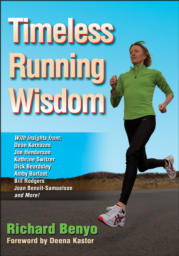
Timeless Running Wisdom by Richard Benyo

I just came across this new book Timeless Running Wisdom by Richard Benyo, which looks great. Here's an excerpt: 

"Millions of runners ply the world’s highways and byways. They weren’t always runners, except in the relatively rare instance in which they ran track and field or cross-country during their school days and continued to do so after graduation.

"Go to any local 5K race and hang around after the race is over and talk to a group of the runners. Ask them how they got into running. If there are eight people there, seven of them will reveal that they weren’t athletes in high school. In each case they will be happy to confirm two things:

1. I never imagined that I was a runner until I became one.

2. I’m more comfortable with myself now that I’m a runner than I’ve ever been in my life.

"The nice thing about running is that the runner is always there, patiently waiting to be released. There isn’t a predetermined starting date or a firm expiration date."

More information, check Human Kinetics

December 20, 2010

The sincerity of running a marathon

Taking on a challenge like running a marathon demands sincerity and commitment. There is no hiding or playing games, especially not in the final kilometres of the 42.195-kilometre challenge. 

As Benjamin Cheever writes in Strides: Running Through History With an Unlikely Athlete:

"I like the people at a marathon. Maybe this is because as a species, we’re so good at concealing ourselves. And the signals we give one another are like the feints a ball carrier might use to outwit a tackler. We hate or love our jobs, depending entirely on who’s listening. We didn’t mean to buy this car. ‘After circling the globe, I never thought I’d wind up in this town.’ ‘I didn’t mean to marry him.’ When you run a marathon, you mean it."

December 12, 2010

What I am Reading: Run With the Champions

Marc Bloom's Run With the Champions: Training Programs and Secrets of America's 50 Greatest Runners is a great book that I've been reading in the past few days.

A couple of quotes that I particularly liked so far were:

"Running has given me so many gifts: courage, responsibility, discipline, motivation - attributes that readily transfer to other of my life. The joy of being physically fit -  physically clean, if you will... Even on days when a run starts out with a little struggle, you come home so refreshed." Lynn Jennings in Bloom's Run With the Champions

"To me, running means freedom, but you need the discipline to gain the freedom." Doris Heritage, who ran a 2:02 800m in 1968, in Bloom's Run With the Champions

October 13, 2010

From Running & Being by Dr. George Sheehan

As I am trying to structure the first draft for a book about running and writing, I looked through the Table of Contents of some of my favourite books to help me define the right one for my book.

And as I reach for Running & Being: The Total Experience by Dr George Sheehan, of course I start reading and cannot stop. This section is from the final chapter titled Seeing:

“… now I begin to get beyond this sight and sound, of observing the road ahead and the water to the side. The running alone occupies me. Fills my awareness. I am a steady flow. I am pure involvement. Total concentration. I am comfortable, calm, relaxed, full of running. I could run like this forever.

"And during all this I narrow my conscience to the immediate moment. I am moving from time measured to time standing still. I am giving up past and future for this now. I am leaving the linear line where my footsteps are a metronome, my pulse and respirations are in harmony,  and every eight minutes I moved my body one mile.

"And for a while I alternate. Briefly, I return to sweat and movement and sun warm between my shoulder blades, the sight of sea and sky. Then once again I am in the now, the eternal present where literally nothing happens. I am suspended, content with the nothing.

"And the peace that comes with it. And that perhaps is the essence of the running experience for me, and any number of different experiences for other people. The lack of anxiety, the complete acceptance, the letting go and the faith that all be well.

"In running, I feel free. I have no other goal, no other reward. The running is its own reason for being. And I run with no threat of failure. In fact, I run with no threat of success. There can be no consequences to make me worry or doubt. I am secure whatever happens. And in that security I reach a wholeness that I find nowhere else.” 

From Running & Being: The Total Experience by Dr. George Sheehan

September 18, 2010

The Marathon: Make time for your training

The final chapter in my book Powered From Within: Stories About Running & Triathlon is about marathon training, originally a feature I wrote for the September/October 2008 issue of Canadian Running magazine.

One of the two coaches I interviewed about marathon training was Kevin Smith. He talked about the importance of making sure that you allocate time in your schedule to train for a marathon, yet at the same the time it's not as time-consuming as you may think.

“We have ways to help people realise what time commitment is to appropriately determine it. Some people overestimate it. You don’t have to change your entire existence, you don’t have to quit your job, you don’t have to swear off seeing your friends, and literature – you don’t have to give up all these things, but you do have to be very efficient about what you are doing and how you do it. 

"We’re talking about 3 to 4 runs a week. Depending on your pace and your volume, that’s going to be anywhere from 6 to 12 hours a week, including cross training.” 

September 17, 2010

The Marathon: Practising race nutrition

The final chapter in my book Powered From Within: Stories About Running & Triathlon is about marathon training, originally a feature I wrote for the September/October 2008 issue of Canadian Running magazine.

One of the two coaches I interviewed about marathon training was Dave Scott-Thomas, head coach for the University of Guelph, who said that a marathoner must practice nutrition during training: “We do a lot of practicing with nutrition. And that goes to me being on the bike when we are doing some long runs with a knapsack full of gels and water bottles and whatnot. We’ve had some sessions where I go and I stash them along the route so the athletes have access to them and I am in my car.

"We found that [one of his athletes] for example wasn’t really adept at taking in water on the run. He swallowed a ton of air. We had to move to different types of water bottles where he didn’t take less air. The fact is that you just don’t need him with a stomach full of air and feeling all gassy while he is running. It sounds simple but we don’t want him out there at 18 miles having to worry about that.

"There were certain types of gels that [another one of his athletes] liked and certain types that he didn’t like and we just learned that by practice, going out for a 22-mile run with a bunch of tempo in it.”

After running 12 marathons (as well as five Ironmans and three ultraruns), of which I've run the past eight between 3hr 07 and 3hr 15, I know my nutrition during the race is crucial. I eat two plain energy bars (I like the vanilla Powerbars) for breakfast at least two hours before the start of the race and also have my regular morning coffee with 750ml of water.

I carry at least 8, sometimes 9 or 10, gels and start taking these 45 minutes after the marathon start. Then I keep having them every 15 minutes. As for hydration, I always have a cup of water at each aid station.

September 16, 2010

The Marathon: It’s all about the attitude

The final chapter in my book Powered From Within: Stories About Running & Triathlon is about marathon training, originally a feature I wrote for the September/October 2008 issue of Canadian Running magazine. 

One of the two coaches I interviewed about marathon training was Dave Scott-Thomas, head coach for the University of Guelph, who said that a marathoner needs, most of all, the right attitude: “A lot of people look at the marathon as a pretty daunting prospect: `Well I’ve got to run 26.2 miles – it is going to be really lonely and it’s going to be all this work and it is going to be so arduous’. 

"And that to me sounds so negative. I look for the runner who says, `You know what, I am going to teach myself something and it’s going to be awesome. I am going to push my comfort zone, I am going to step into some new turf where I haven’t been before, I am going to jump off the cliff to see if I have got wings, and I am really motivated to do it. 

"And yes it is going to be hard but I want to answer the question how good I can become’. And I think the marathon is really about that because it is a pretty tough journey,” according to Scott-Thomas.

September 14, 2010

How long does it take to start running?

Getting fit enough to run 20 to 30 minutes comfortable is not as hard as you may think. Susan Griffith, one of the two top running coaches I interviewed for my first book Running Shoes Are a Girl's Best Friend has been teaching a six-week Learn to Run course for years.

Susan says she has seen big transformations take place in this clinic. Many beginners can’t run 100 metres when they start the course and are amazed at their improvement in less than two months. “I see them often shocked that they are able to run 3km or 4km without stopping by the end of week six. At the start of the clinic they never believed they could do it. That’s the most powerful thing that happens,” Susan says in Chapter 2 of Running Shoes Are a Girl's Best Friend.

While I didn't seek guidance from a professional coach like Susan, my experience when I began running from scratch in 1996 was very similar. That first five minutes, which was all I could do that day, was a hard slog. Despite the fact that it was tough I felt good afterward, a sense of accomplishment even from that small outing.

That helped motivate me to keep trying to run short stretches regularly and before I knew it, I was able to run more than an hour. I don't remember whether it took weeks or a few months before I reached that goal. And that is not really the point - the key is that when I first struggled through that five minutes I never even considered the possibility that I might run longer than an hour comfortably.

If you'd like to read more of Susan's advice and her experience as a coach and a life-long runner, please go to the free document on Scribd here.

I love running and truly believe that Running Shoes Are a Girl's Best Friend!

Before you start any exercise program, of course always check with your GP first!

August 11, 2010

What I am reading: Racing the Antelope

In chapter two of Racing the Antilope: What Animals Can Teach us About Running & Life by Bernd Heinrich, he says:

"With the help of our infinite imagination and the technologies it has produced, we now travel faster, more economically, and well beyond the range of our muscle power. But for millions of years, our ultimate form of locomotion was running. We are, deep down, still runners, whether or not we declare it by our actions. And our minds, as much as our lungs and muscles, are a vital force that empowers our running."

"I've run at varying distances and intensities almost all of my life, probably because the primal unadorned simplicity of running appeals to me. Various games incorporate running, but only running itself touches the pure and basic essence of the tension between speed and endurance, stripped bare of our everyday world of technology, beliefs and hype."

August 06, 2010

What I am reading before STORMY

This week I started reading the Lore of Running by Tim Noakes. Until now, I think its sheer volume at 900-plus pages put me off and I now realize what a mistake that was. Better late than never.

It's especially great to read chapter 11 titled Ultramarathon, even now with only two days to go until I start my first 50-mile race. I'll highlight a few great tips below.

While the training schedules for ultramarathons in Chapter 11 confirm what I already knew, that I am a bit underdone in terms of training with my longest run only having been four hours, I take heart from a line in Chapter 10 titled Marathon (p.634 in the fourth edition):

"Tom Osler (1978), one of the first modern proponents of walking in racing and training, concluded that anyone capable of running 42km can easily run 80km if they alternate regular walking and running in the ratio described previously."

The ratio referred to is one of three described in the book's previous paragraph:
- 20 to 25 minutes of running, followed by 5 to 10 minutes of walking 
- walk 1 minute for every 5 that you run
- if a hilly ultra, walk only on the uphills and run the rest. 

Key points of advice from Chapter 11 Ultramarathon:

"During the final 24 hours before an ultramarathon, it is especially important to be on your feet as little as possibly. You should rather indulge yourself by doing absolutely nothing physical besides that which is necessary to read or watch TV or videos."

"A prerace breakfast is, in my view, essential before any ultramarathon."

"...the goal, at least for the first half of the ultramarathon, should be to enjoy yourself by talking to other runners and enjoying the scenery and the occasion. ... you need to enjoy the race as much as possible and try to make the moment last as long as possible. Your first ultramarathon may be the most exciting race you will ever run and will probably be the one you remember most fondly."

"But reality will unfortunately intrude sometime after halfway, as the pain and discomfort envelope you. At this stage of the race, you need to develop the skill of focusing on the moment - on each running stride - and to be unperturbed by the considerations of how far you still have to run."

"Correct pacing is essential for any race. But the consequences of poor pacing in a ultramarathon are always devastating. The general rule - that each minute that you run too fast in the first half of a10-to 42km race will cost you twice that time in the second half - probably does not apply to the ultramarathon. Here the cost of each minute run too fast in the first half of the race may be more like 3 or more minutes in the second half."

"Bad pacing in a standard marathon may leave the athlete with, at worst, 12 to 14km of discomfort. By making the same mistake in the short ultramarathon, you could end up having to struggle 30km or more until the end. The solution, then is to start all races conservatively, aiming to run the first half easily according to the body and using what is left in the second half."

"... it is usually best to run through that section of the race that is the most difficult - the last quarter - as quickly as possible, but to delay the time of reaching that point for as long as possible. This is best done by starting very conservatively and saving your effort for when it is needed."

"... hourly fluid requirements are somewhat less during ultramarathons than during marathons. However, the requirement for ingested carbohydrate, especially near the end of short ultramarathons, is probably greater than during marathons, provided you are still running at a reasonable intensity and have not started walking or jogging more slowly."

And one of my favourite quotes is from Noakes' introduction where he says:

"Even in the most crowded races, the point is reached when fatigue drives us back into ourselves, into those secluded parts of our souls that we discover only under times of such duress and from which we emerge with a clearer perspective of the people we truly are."

July 06, 2010

What I am reading

I just finished Bart Yasso's My Life on the Run: The Wit, Wisdom, and Insights of a Road Racing Icon and Pam Reed's The Extra Mile: One Woman's Personal Journey to Ultra-Running Greatness and highly recommend both books, especially to runners.